 The lavenders I referring to in the title are my tender lavenders that we planted in the ground earlier in the season. The lavender at the right is a green fringed lavender or maybe its the grey fringed (Lavandula dentata) that is tender in our area and has been in this pot all season. It is in a beautiful pot that has lavender on the side with its meaning in the language of flowers. It is the herb of devotion. I have several others that are in the ground and doing well. My herbal husband has already brought in the Peruvian Salvia. Remember I told you it was going to happen. Well today, he asked whether we were going to bring in the other lavenders. I have a sweet lavender (Lavandula heterophylla), grey fringed lavender (Lavandula dentata var. candicans) and a beautiful silver lacy leaved lavender called (Lavandula buchii var. buchii) which is pictured below on the top. The sweet lavender is on the middle. The green or grey fringed on the bottom. They all may be saved! I'll let you know. The garage is going to be full!
Thursday, October 9, 2008
Are We Bringing in the Lavenders?
The lavenders I referring to in the title are my tender lavenders that we planted in the ground earlier in the season. The lavender at the right is a green fringed lavender or maybe its the grey fringed (Lavandula dentata) that is tender in our area and has been in this pot all season. It is in a beautiful pot that has lavender on the side with its meaning in the language of flowers. It is the herb of devotion. I have several others that are in the ground and doing well. My herbal husband has already brought in the Peruvian Salvia. Remember I told you it was going to happen. Well today, he asked whether we were going to bring in the other lavenders. I have a sweet lavender (Lavandula heterophylla), grey fringed lavender (Lavandula dentata var. candicans) and a beautiful silver lacy leaved lavender called (Lavandula buchii var. buchii) which is pictured below on the top. The sweet lavender is on the middle. The green or grey fringed on the bottom. They all may be saved! I'll let you know. The garage is going to be full!


Wednesday, October 8, 2008
A Surprise Perennial in My Garden
 Rudbeckia herbstsonne is a real surprise in my garden. I love it because it's so tall and that it is still flowering late in the season. The bees and butterflies love the flowers and the birds love the seedheads. It is an all around winner!
Tuesday, October 7, 2008
Huacatay-Herbal Husband's Favorite Peruvian Herb
 There is Huacatay (Tagetes minuta) everywhere in our garden. It is native to southern South America and is used as a condiment to enhance sauces. We gave a lot of it away to a local Peruvian restaurant. It has flowers, but you grow it for the leaves.
 It is an acquired taste just as cilantro is. Because it is in the marigold family, it has that marigold taste and smell to it. Here is a website from Purdue University on Huacatay. Hope you learn about this interesting herb from Peru.
It also grows into funny shapes! It is taking a bow in our garden.

Monday, October 6, 2008
Second Bloom of Lavender
 If you cut your lavender in June or July, you may be able to cut a second harvest around this time of year. This bouquet consists of 'Hidcote' and 'Munstead', the two lavenders most hardy here in western Pennsylvania along with some others. We are going to have temperatures in the low 40's tonight and the wild process has started to cut all of the herbs that are on my list. It is not a big list, but I will have to start thinking about what to cut next! It is all a process and the more organized you are, the easier it will go. I need to check on the tea herbs that were cut last week. I think they are ready to be mixed and stored.
Sunday, October 5, 2008
We Don't Have a Window Big Enough for this Lemon Verbena!
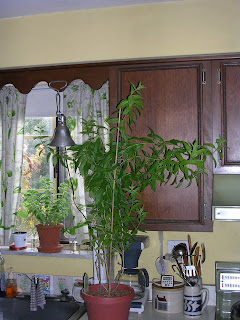
As I have said in numerous postings, this has been a great season for herbs in containers. This one to the right is the lemon verbena that is coming inside. It will lose most of its leaves after coming in. More lemon verbena bread on the horizon! Also a lot of tea. It makes a great cup of tea in the winter. I made 12 jars of lemon verbena jelly yesterday. Changed the recipe up so I will have to let you know how they turned out. Hope you are enjoying the warm weather where you are. Not quite Indian summer yet. Haven't had a frost. It was a fabulous day in western Pennsylvania.
Saturday, October 4, 2008
My Herbal Husband and His Potpourri!
 We have been cleaning out our garage and basement! This morning I was working on some lemon verbena jelly and my husband was finding some older dried herbs. I told him just to compost them. Without my knowledge, he had been saving all of the older dried herbs during the season in a plastic bag! Hopefully, when we really get things organized, I will be able to add some fixatives to the dried mixture to make a satisfactory potpourri. One that my herbal husband will appreciate.
Friday, October 3, 2008
Gray Skies in the Herb Garden
 We have had a string of beautiful sunny days in the garden. This picture shows how it really is in winter in western Pennsylvania. Dreary to say the least. I think though that you will see how herbs do lighten up a landscape even when it is a rainy, cloudy day in the garden. Herbs are a positive influence in my garden.
P.S. I think the hummingbirds are gone from the herb garden until next year!
Thursday, October 2, 2008
An Herbal Bouquet Keeps the Blues Away!
 I always try to have an herbal bouquet on our dining room table in the summer. Since the days are much cooler and there aren't as many flowers in our garden, it is even more important to bring color in when you can. This particular bouquet has tansy flowers, a Fairy rose, pineapple mint, orange mint, lemon balm, golden sage (although it looks very green) and calendula which is this year's herb of the year. In the background is a bunch of 'Minette' basil in water. We still have wonderful tomatoes to make salads! Can't cut all of the basil! Basil resents temperatures in the 40's and starts to turn black. So I wanted to make sure that I didn't forget it in the garden. Bring in the herb garden while you can and brighten your day!
Wednesday, October 1, 2008
An Herbal Space Hog!

My husband has a hard time with the word "thin" and therefore, we get pictures like this one above! The borage (Borago officinalis) is a small plant coming out of the ground and then it morphs into this space hog that buries others in its way. I had to take it out of my herb garden because it had reseeded everywhere it was not wanted. When my neighbor gave me some plants, I was teaching a class on edible flowers and it is a blue one. Two great characteristics! When it first started to bloom though, it was pink! I said to my neighbor, I got the wrong plant. She laughed and said that the blossoms go from pink to blue and she was right. See the photo below. Never eat a whole bunch of any particular flower. Stay away from eating this flower if you are with child. The sunflower is a survivor and the others are cantalopes that will never produce a fruit because there isn't enough time! It's wild. The cantalopes come from the compost that we make in the back of property.

Subscribe to:
Posts (Atom)